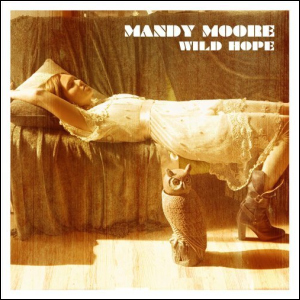
It's been four years since a Mandy Moore album has been unleashed into the world; six if you only count original material and not Elton John and Carole King covers.
Wild Hope, Moore's official return to music after spending a few years expanding her filmography, is her bid for credibility; a twelve track exercise in furthering
Coverage's attempt to rid her choreography-accompanied past in exchange for a more natural, singer-songwriter style. Inspired by an immensely respectable list of artists (Joni Mitchell, Patty Griffin and Wilco included) and produced by John Alagia, the man best known for his work on releases from John Mayer, Dave Matthews Band and Jason Mraz, Moore has co-penned each song here, assisted by singer-songwriters Lori McKenna, Rachael Yamagata and Chantal Kreviazuk, as well as indie folk-pop duo the Weepies and former Sky member (and writer of Moore's 2002 single "Cry") James Renald. Her straightforward lyrical approach leaves little to hide behind, and rarely does her delivery come off as anything other than genuine. Despite revolving mostly around the disappointments of love, this is a breezy, feel-good collection of songs, seemingly tailor-made for long, dusty summertime drives with the top down. It's also an appropriately titled release, as even its most melancholy lyrics have a ring of optimism surrounding them. The album opens with its first single, the casual and comfortable "Extraordinary," a song that speaks of breaking free from playing second fiddle to the Britneys and Christinas of the world:
I was a starling, nobody's darling
But you might see me in the corner of your eye
And now I'm ready to be extraordinary.
Whether it's the infectious sing-along choruses of "Nothing That You Are" and "Slummin' in Paradise" or the vulnerable confessions of "Gardenia" and "Most of Me," Wild Hope remains fully content in the space it occupies, uninterested in grasping for artificial depth while simultaneously avoiding the desperate hunt for a hit. The album isn't without a few bumps: "Can't You Just Adore Her?" and "Few Days Down," are so faint they struggle to leave a lasting impression, while Moore's affected vocals on "All Good Things" are out of place among a record full of strong performances. However, these bumps are minor, as there isn't a single track that isn't at least pleasant when it's playing. Wild Hope is still more polished than organic, but the difference between it and the vast majority of polished pop is that there are actually songs, and good ones at that, underneath the sheen.