Not Herself Tonight: Revisiting Christina Aguilera
Not content to merely listen to her favorite records, Christina Aguilera has made a career out of duplicating them. In just a few short years, she's blatantly swiped inspiration from everyone from Mariah Carey to P!nk to the Andrews Sisters. And despite her persistent regurgitation of Madonna's sexual politics speel, her ambition always involves adopting a new high-concept persona and being anyone but herself. It's hard to flip through Aguilera's brief discography and not feel like we've all witnessed a decade-long identity crisis. Either she's never evolved past being anything more than a well-paid mime or she just really enjoys playing dress up. Her output is a constant clash of contradictions, where every positive can be countered with an equally important negative. For starters, she has a jaw-droppingly powerful voice, but doesn't understand the importance of subtlety. She conceptualizes her albums to be thematic events, yet relies on a calculated and ever-changing image to get her point across. And when finding herself trapped within a genre that she's been bizarrely assigned to, she defaults to the oldest trick in the book: play by pop music's rules and yield her sexuality as her main appeal. It's been somewhat maddening to watch a woman with that voice believe that taking her clothes off is necessary, especially when she's the last person in pop who would need to lean on such a gimmick.
With Stripped, it almost felt like she was on to something. Even if history may remember it more for Aguilera's scant warbrobe at the time, it's a damn good pop album. Free from the constrains of a ploy, it's just Aguilera spilling her guts across seventy-seven minutes of R&B, rock, pop and adult contemporary anthems. And despite the fact that only two of the twenty tracks contain suggestive lyrical content, that didn't stop AllMusic's Stephen Thomas Erlewine from describing the album as both "hyper-sexual" and "carnal." There's no hiding such an uncomfortable case of judging a book by its cover, as one of music's most respected publications seemed to give more weight to the accompanying booklet photos than to the actual music itself. The era's visual presentation even made radio balk, as the fairly conventional first single "Dirrty" stalled on the charts at #48. But while Stripped was a severe study in misaligned promotion and product, Bionic seems to find Aguilera interpreting previous criticism as inspirational. There's not much going on below the surface this time; just a series of sexbot come-ons courtesy of a latexed shell.
So where does she go from here? Aguilera's at her best when attempting to channel the retro soul that she loves, but falters when she gets caught up in contrivances that hamper each album's overall impact. Her unwillingness to edit resulted in the overlong and therefore watered down Back to Basics, when a superb album is hiding amongst the surplus, and though preliminarily bold on paper, Bionic is ultimately a fizzled experiment. Less talk is also bound to work in her favor, as Aguilera's own hype usually proves misleading. Her two year stint of bombastically ballyhooing her electropop reinvention resulted in nothing more than painfully anticlimactic Polow da Don throwaways. Based on her ceaseless discourse, Aguilera's aim is for something substantial. It's time for her actual output to do the talking.
Stripped (2002)
For all the tabloid-worthy "the genie's a slut" jabber that lead single "Dirrty" inspired, Stripped actually turns out to be a by-the-book excursion in Top 40's definition of female self-empowerment and self-worth anthems. Featuring guest spots from Redman, Lil' Kim, Alicia Keys, Dave Navarro and ?uestlove with production by Scott Storch, Linda Perry, Glen Ballard, Rockwilder, Steve Morales, Rob Hoffman and Heather Holley, Aguilera's follow-up to her self-titled debut (sans Spanish and Christmas projects) manages to be thoroughly enjoyable despite being such an unfocused genre- and producer-hopping collection. It is a conceptually predictable affair and thus can't live up to Aguilera's self-proclaimed affinity for risk-taking, but with songs as strong as the rich blues-influenced "Walk Away" and sepia-toned "Cruz," it's hard to care if Stripped is following down a formulaic path. Though recent photo shoots and wardrobe choices may lead you to think otherwise, Stripped's scattershot subject matter only once delves into the overtly sexual and instead focuses much of its attention on the inspirational and the self-promoting. Owing much to Mariah Carey in terms of influence, ballads like the singles "Beautiful" and "The Voice Within" offer words of encouragement to Aguilera's audience while the rock-influenced "Make Over" and the gospel-infused "Soar" speak of preserving one's individuality. At twenty songs and nearly seventy-eight minutes in length, Stripped would benefit greatly from a tracklist trimming, as unnecessary interludes and mediocre numbers dilute the overall effect that the album's better moments offer. But if Stripped is any indication, Aguilera is capable of far more than her pedestrian pop beginnings proved.
Back to Basics (2006)
If one happens to approach Back to Basics, the first release from diva-in-training Christina Aguilera since 2002's Stripped, unaware of the pop star's recent repetitious media pitches and image overhaul, they won't remain in the dark for long. The scene is immediately set, with names dropped (Etta James, John Coltrane, Ray Charles, Miles Davis, etc.) and assertions made:
We're gonna set the mood
Gonna go back to an old school groove
Gonna rewind to another time
When the originators, innovators were alive.
Such dissertation is normally reserved for pre-release hype exclusively, so to find it infiltrating two songs within the album's first ten minutes may be surprising for the Aguilera uninitiated. Though this dumbing down of concept may prove useful for her jazz- and blues-challenged fans, it unfortunately comes across as awkwardly overcompensating. If you're going to do something, don't talk about it; do it. Yet despite Aguilera's insistence upon repeatedly walking us through exactly what we're supposed to be getting out of her newest musical reinvention, it's hard to fault her ambition. Encompassing twenty-two tracks spanning across two discs, giving her ample opportunity to ape everyone from Fiona Apple to the Andrews Sisters, Back to Basics is meant to usher in Aguilera's own brand of artificial antiqued nostalgia, as well as set her up as a serious and respectable artiste in the eyes of her audience and peers.
While the first disc is dominated by sample-strewn and retro-infused modern R&B helmed by DJ Premier, Mark Ronson, Kwamé, Rich Harrison and others, it's the second disc, produced by Linda Perry with a more conventional approach to this vintage-styled pop, that has the most to offer. The fantastically freakish carnival curtain-raiser "Enter the Circus," which sounds straight out of a Danny Elfman-led Tim Burton film score, opens the show before bleeding into "Welcome," a strings-laced epic that slowly winds out of control before its two and a half minutes are up. With the exception of "Nasty Naughty Boy," the only time Aguilera's posing crosses over into cartoonish territory, disc two works and, at times, even exhibits true emotion, particularly on the regret-driven ballad "Hurt" and "The Right Man," Aguilera's wedding day ode to breaking the fractured family cycle. Other highlights include the "Boogie Woogie Bugle Boy"-esque "Candyman," the gorgeous "Mercy on Me," which sounds pulled from Fiona Apple's back catalog, and "Save Me from Myself," where the quintessential banshee wails are put away in favor of subtlety for once.
Yet despite how enjoyable the nine-track second disc proves to be, it can not make up for the back half of the first one, which, bogged down by soggy throw-aways, is almost entirely skippable. Whether you look to the self-defeating "F.U.S.S." or the braindead concoction that is "Still Dirrty," it's hard to believe that the Aguilera who sounds so uninspired and aimless here is the same Aguilera who will soar through the Perry-piloted numbers minutes later. Back to Basics is admirable in concept and frequently well executed, but, just as it was with Stripped, has been watered down by Aguilera and company's inability to trim away the excess. Slim it down to one disc, and convince Aguilera to do away with the thinking that the image supplied in glossy booklets will make up for any musical shortcomings, and you'd be holding on to an album that doesn't leave you with the overwhelming sense that what you're listening to is a wasted opportunity.
Bionic (2010)
Be careful what you wish for. After years of hoping that Christina Aguilera would drop the self-seriousness long enough to stop desperately trying to prove herself, she comes up with the frustratingly lifeless Bionic. What was misrepresented as an experimental and futuristic foray into electronic music, aided by a stable of the genre's best, is in reality a juvenile, clumsy farce in which inspiration seems absent. There's even a downside to the album's strongest tracks, the Switch-produced "Elastic Love" and "Bionic," as they ape their influences so thoroughly that they all but disappear. Why listen to Aguilera's inconsequential interpretations of M.I.A. and Santigold when we already have Kala and Santogold? After repeatedly name-dropping those two women, along with Ladytron, Goldfrapp, Le Tigre and Sia, as co-conspirators, Aguilera seems to have shifted gears mid-album, diluting Bionic's tracklisting with feeble, dated offerings from Tricky Stewart, Polow da Don and Focus.
With the Ladytron and Santigold collaborations relegated to bonus tracks on the deluxe edition of the album and Goldfrapp's presence withdrawn entirely, M.I.A. and Le Tigre are left to contribute one track apiece. In the end, Sia is the real survivor of these much-hyped songwriting sessions, as three of her four co-writes remain. And yet, her best ballad hit the cutting room floor, banished to the b-side bin with other songs infinitely more interesting than the junk that remains on this strangely sequenced trainwreck. Odes to make-up, oral sex and ... sex abound. There's the schoolyard chant "I Hate Boys," which finds Aguilera rhyming "bananas" with "bananas." There's "Glam," where she encourages listeners, in a moment you can only hope is parody, to "be superficial." She strikes a sexbot pose on "Desdunate," weds herself on the hilarious "Vanity" and comes up with a new use for the word "woohoo" ...
All the boys think it's cake when they taste my woohoo
You don't even need a plate, just your face
Licky licky yum yum.
Who knew that Aguilera's vision for the future was so inane? Who knew that four years of development would result in something so lackluster and half-hearted? There's not a single song here half as good as the better moments on Stripped or Back to Basics. Even Aguilera's teen pop debut wasn't this creatively inept. In fact, Bionic would be entirely forgettable if it wasn't so damn flabbergasting. After nearly a decade of ardently attempting to stand out, there's not a lot here that would sound out of place coming from today's gaggle of interchangeable Auto-Tuned popsters. Bionic has some really dubious decision-making on display and will probably wind up as something that Aguilera would like to pretend never happened. It's ultimately a visionless testament to what could have been.
 REVIEWS INTERVIEWS ARTICLES BLOG ABOUT RADIO

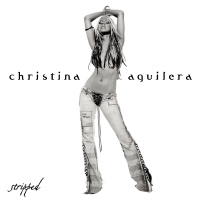 Stripped (2002)


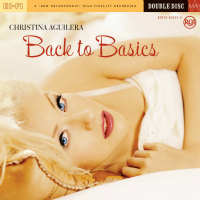 Back to Basics (2006)
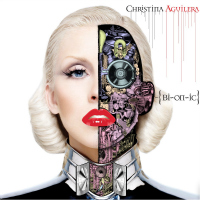 Bionic (2010)
